.
Listen Now
Watch the podcast video on YouTube here!
Show Links:
Launching or growing your business to $100K? Start with the signature Food Business Success program with 5 months in the Fuel membership too.
Ready to scale your business to $300K and create more freedom of time and money? Apply for Master Your Business here.
Find free and low cost workshops on the resources page.
Join the free Private Food Business Success® Facebook Group
Follow us on Instagram
Full Transcript
Sari
Welcome to your Food Business Success. This podcast is for early stage entrepreneurs in the packaged food industry ready to finally turn that delicious idea into reality. I'm your host, Sari Kimbel. I have guided hundreds of food brand founders to success as an industry expert and business coach, and it's got to be fun. In this podcast, I share with you mindset tools to become a true entrepreneur and run your business like a boss, interviews with industry experts to help you understand the business you are actually in, and food founder journeys so you can learn what worked and didn't work and not feel so alone in your own journey. Now, let's jump in.
Sari
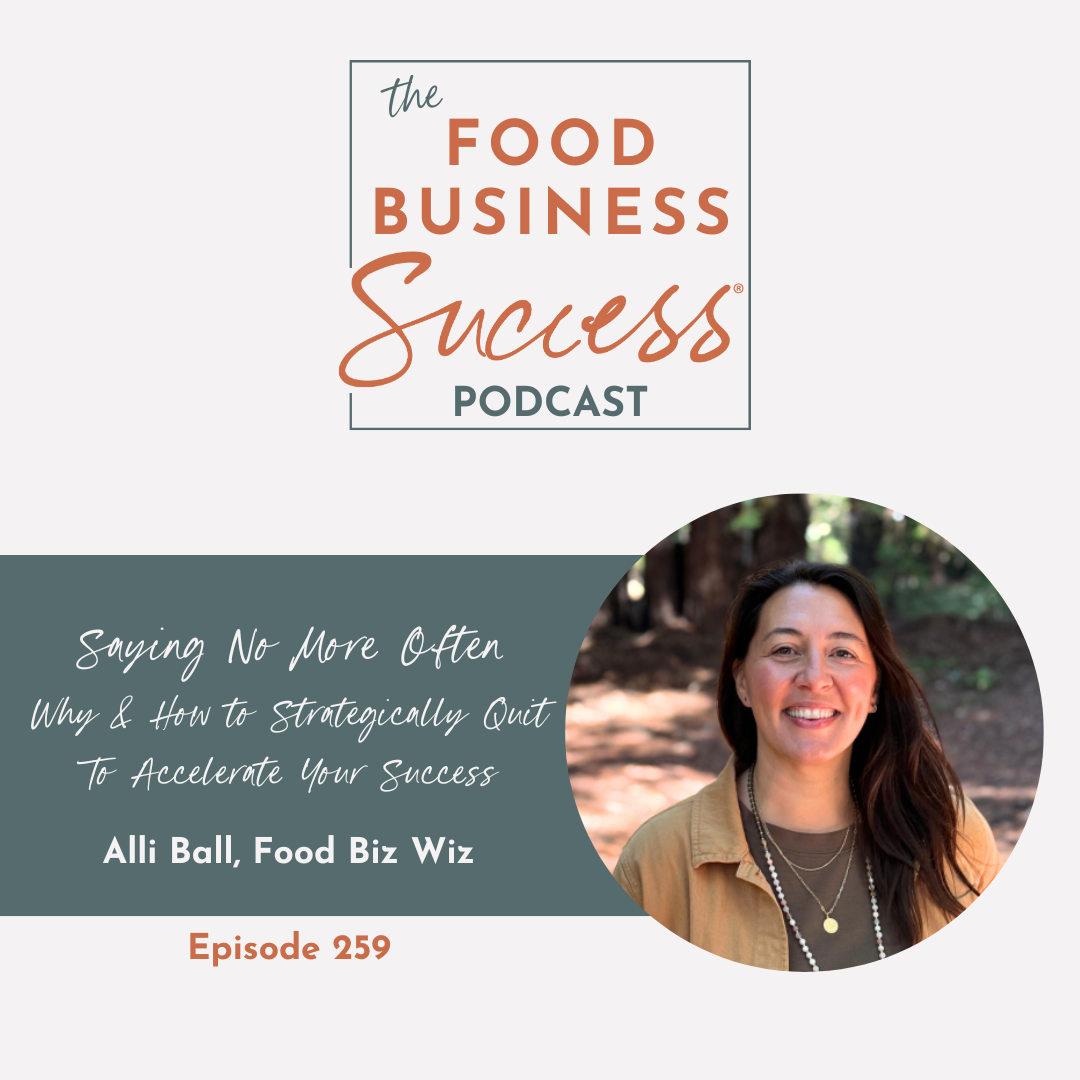
All right. Welcome back, everybody to the podcast this month, I'm so excited, really excited, to welcome an amazing guest. I feel like, who needs no introduction, but we will, I will introduce her. So Allie Ball is with us today. And Allie is the creator of Retail Ready and the founder of Food Biz Whiz, and she was on the podcast. We were just looking it up, podcast number eight, way, way back when. And I'm so excited to have you back on the podcast. Welcome Allie!
Allie
Thank you. I'm excited to be here years later. Wow. Congrats on 250 plus episodes.
Sari
Thank you. And you as well. You had a podcast for almost five years, 250 episodes.
Allie
Thank you. It's, it's a lot, and it's related to what we're talking about today.
Sari
It is. It's a great, yeah, it's a great segue, for sure. So, but really quick, I'd love for you to, in case people don't people literally, I'm like, you've never heard of Allie Ball. How are you in CPG, this name has not come into your life, but in case somebody has no idea who you are, can you tell us a little bit about your background?
Allie
And I'll say, I meet people every day in my DMs who have no idea who I am, so I'm always grateful for the opportunity to meet new people, and it certainly happens. So I'm Allie. I'm a former grocery buyer turned wholesale strategist, and like you said, the founder of Food Biz Quiz and the creator of the Retail Ready program. So we are the longest running online sales training in CPG, we've had over 3500 food, beverage, health and beauty, pet brands go through our sales training, and it's all about how to get your products in wholesale accounts and how to increase sales once there. So I bring my background as a grocery buyer, that lens of what the buyer truly wants from brands, how to speak the language of that wholesale buyer, into everything that I do. I'm also a certified coach, leadership coach, so we do a lot of coaching with brands and with founders. And what else do I want to say about myself? I'm an enthusiast of rest. I'm all about entrepreneurship, but, like, my big passion is, is rest.
Sari
Yeah, it's really fun. I mean, you and I connected when I started. You started about a year earlier than me and then, but we kind of have similar backgrounds, both buyers in grocery and we connected in 2019, and you know, have been in each other's world since then, in connection. And it's so interesting to even look over those six years and you've been in business seven years, but like, how much you and I have both evolved and changed, and our businesses have changed and we've both quit a lot of things.
Allie
Yes, absolutely. And you know what's wild is, I started Food Biz Wiz 12 years ago. It'll be 12 years, you know, in 2026 but we didn't launch Retail Ready until yeah, about five years into my business. Seven years ago or so, and when I was prepping for this episode and thinking about all the things that I've quit along the way, one of the big ones was that evolution of Food Biz Wiz that allowed for retail ready to come in. So I don't know. It's just so wild. It's so wild to have this opportunity to reflect on quitting and saying no to things and the evolution. So I'm really one, I'm just grateful for the opportunity to reflect on that. And I'm really excited to talk about this topic with you.
Sari
Yeah. So Allie and I were chatting a couple weeks ago, and we were talking about the need to quit things and why that's so hard and why that's so scary. And you and I both coach founders as well as ourselves, and we see it in our own lives, but if we think about our audience listening, you know our CPG founders and that it's so hard to quit things, and I'm sure, from the outside, when we're coaching, we can see it so clearly, but it's so hard when you're in it. And I'm curious, just to start out like, why do you think it's so hard as humans for us to quit things?
Allie
Yeah, I think there are few reasons. But if we look at it from this entrepreneurial lens, I think that this is, this is one of the biggest misunderstandings in entrepreneurship, right? We glamorize the beginnings, the launches, the new offers, the new strategies, like all of that shows externally and internally. I would say that we're doing something. We're being productive. We're getting it done exactly. We're getting gold stars as entrepreneurs. We're probably also like all high achievers and people who really like functioning at a high level and the quitting, the ending of something, unless we tell ourselves the real story about it can feel like the opposite of that, right? If we're all about celebrating output and the beginnings, then the ending of something can carry a lot of weight with it. We can feel like it's a sign of failure, even though you know you and I both know that's not true,.
Sari
The story, the meaning that we give it, and let's face it like, especially in the US, in a culture like we're inundated with, like, just, you know, go, go, go, say yes, yes, yes, hang in there, no matter what, grit, you know.
Allie
Yeah, more more, yeah. And, you know, again, I think I'm glad we're talking about it through this lens of entrepreneurship, because I know that's both of our audiences, that we are trained for output. We are rewarded for output. So naturally it feels, I don't know it can feel really hard, icky, shameful, embarrassing to quit things. Yeah, it's not true though.
Sari
It's not. And as I was thinking about this episode, I was also thinking about, you know, we also, in human nature, we have something called the loss aversion bias, right? Where, like, we hate to lose things. You know, you could be something that's in your house that you're just like, man, whatever. But like, if it were to break or get lost or something, you know, we feel this deep loss for things much more than gaining even. And then there's also, like, the sunk cost fallacy, where, like, we're in it. We put so much time, we put energy, we put money into things. And like, I just got to stay on this path. I got to grind and push and hustle.
Allie
Totally I, actually, I went to a lecture a couple weeks ago that was all about the sunk cost fallacy, and it was by Berkeley professor and researcher. And, you know, gosh, I should, I should pull this up, and maybe we can link his study in your show notes. But he talked about how, you know, they did all these controlled tests and put people essentially in like a labyrinth of sorts, where and they were testing like how quickly they got out, how quickly they made it to the exit, and even when the participants knew that the shorter route was to double back on their path and they could get out faster. People refused to do it, even when they knew that they would, you know, win the maze. Win the labyrinth. If they doubled back. They refused to do it because there's something in our brain that doesn't want us to retrace our steps, move backwards. Have this story about, you know, loss of momentum and so much so that people will literally, like, take the longer route, just so they don't have to do the doubling back. It was wild.
Sari
Oh my gosh. I can totally see myself in that, like, I would probably be like, like, really hard for me to do it.
Allie
Yeah, well, and what was also interesting is, you know, there was then the perception that people thought that they could that, even though they knew, hey, if I go back, I'll get out faster. They were like, oh, but if I just, like, run in the labyrinth, like, I can beat that time, or like, oh, but I'm different. I'll go faster. I'll like, now that I know this path, I can, like, choose this other one, and I can still win. And it doesn't happen. Yeah, it's wild to me.
Sari
Oh my gosh. I love that. I love that science is like helping us to understand our wild human brains and I think the benefit of that is when you understand like, oh, you can see it for what it is, then we can start to be more intentional about quitting and reframing it. And I love the quote I mentioned you by Seth Golden, winners quit all the time. They just quit the right things at the right time. So I'm so curious, how do you, as you're coaching all of your founders and retail ready and your one on one clients, what's the process? Or how do you help people through when it kind of you, maybe you start to see, ooh, there might be something worth ending here.
Allie
It's a big question, right? And I'll say, ideally, with a longer term coaching client, we have a foundation of understanding what's important to them in the first place. When I start with a coaching client, I take very few one on one coaching clients, but when I do typically, we start with an exploration of who they are, what are their values, what lights them up, what's in their drudgery zone? You know, what makes them passionate about life? Usually, we're coaching through the lens of their business, but not always. And so it really is this examination of what does that well rounded, fulfilling life look like to them. And so typically, the red flags start to appear when folks are, you know, it's all those classic signs, exhaustion, burnout, resentment, lot of resentment. Like, that's a big red flag, obligation, doing things out of obligation that, like, deep down they know they don't want to do. So my job as a coach is to listen for those things. Oftentimes they come with, you know, words like should or have to. And so as a coach, you know, if we're listening for these signs, you know this too, right? So we're trained to listen for things like that. And so I would say the first part of the process, one is just having that baseline, really understanding my client, you know, or helping the client, the founder, understand themselves, right? They gain that awareness about themselves, about what do they value? What is that fulfilling life for them? And then listening and watching for those signs of, you know, burnout and obligation. Does that make sense? Like that's where we started. It's just like the scanning of the horizon, like looking for those signs.
Sari
Yeah, 100%. So when you're like hearing those things and they're coming up in conversation, I'm just, you know, for people listening, if maybe they're noticing, I've been saying these words a lot like, I have no choice, and I have to, and I should, and your energy and your enthusiasm is dipping. Or, you know when I know those days when it's just like everything feels so hard. It's like, one day here and another day here, but like when you start stringing together multiple days of hard I think that's a point to.
Allie
Yeah, and I'm really glad you said that, because I want to be clear that running a business is not all, you know. Find your passion. And work in your zone of genius, you know, like, get in, get in your flow, and it'll all just feel smooth and easy. That's not true, right? We all have things that are challenging for us in the business, when we're learning new skills, when we're at our growth edge, that can be really uncomfortable, right? It's not, it's not going to feel easy every day. And so I don't want, I really want to make sure that our listeners aren't conflating this idea of it's hard, so I shouldn't do it, or it's hard, so that must mean I'm no longer passionate about it. That's not true. So, yeah, you know, I think there's once we start, like hearing those, those words, once we start, you know, noticing the body language, noticing the general malaise that comes into the coaching sessions, we can start to assess whether something is coming to its completion, whether we should stop doing something, or shift doing something, or if really, we're just in a challenging part of the business. And there's a couple steps that we that I like to take someone through, and I'm happy to talk a little bit about if we want to dive in. Yeah. Okay, so first, first, I always do a bit of a check in around the why behind the discomfort, right? And I just alluded to this. But is it difficult? Is there discomfort here? Because I'm in a growth period, learning a new skill, trying something new at the edge of my ability, right? Of what I know, and that just requires discomfort, right? Like, I'm sure you've learned a new skill. Oh, I mean, gosh, over the past seven years, you've learned lots of new skills, I'm sure you understand that that feeling of discomfort just because you're in at a growth edge, right? And that's very different than being out of alignment, right? So we want to discern, is it difficult because I'm growing, or is it difficult because it fundamentally isn't in alignment with who I am as a person, what I value in my day to day, what where the business is going, and what our focus is this season, like, which one is it? And you know, again, that takes, like, some powerful questions. It takes a little bit of self discovery and vulnerability to be able to assess that, but first, we really just check in with the why around the discomfort, like what's the root of this?
Sari
And one thing I've really appreciated, and I've learned from you, is businesses are boring, like a lot of it is boring. And every time I, like, just sometimes I'm in things and I'm like, gosh, the boring I'm like, oh, Allie.
Allie
Yep, oh my gosh.
Sari
You're not supposed to be like, This is awesome and so fun. Or even like, I'm at my edge, and it's like, like, sometimes business is just about like, doing boring things and consistency in order to get what you want.
Allie
And I would say, actually, that that is, I'm thinking of a coaching client I have right now, actually. And one of the things that we have been talking a lot about, is it uncomfortable because she's bored, and that's basically what it is. So she's, you know, been running her business for, I don't know, probably six years or so, and she was talking about saying the same thing over and over and over again on her social media. She's like, how many times I'll make up an example, but how many times can I talk about muffins on social media? I know, right. But she's like, I have to talk about my muffins over and over and over again, and it's really freaking boring to her. I would say, okay, good job. Your growth edge now is being able to sit in this discomfort of boredom, and, you know, maybe, sure enough, we'll fast forward and we'll figure out that, you know, she never wants to talk about muffins again, and then like that. That could be, you know, the next step for us there. But yeah, it's really important to discern if you are over it, like fundamentally out of alignment, or if you're just bored in your business.
Sari
Right, or uncomfortable.
Allie
Yeah. So we really check in that first step is checking in with a why behind that discomfort. From there, we move to the numbers. So I think oftentimes people think about coaching as being really like, woo, woo, and just checking in with the feelings and like, that's it. But business coaching and leadership coaching, I find the style that I do really blends both. So we looked at the discomfort here, or like the, you know, the boredom or the frustration, or whatever it is, through this lens of the numbers and the energy, right? So the numbers are giving you one story about what's happening in your business, and then your energy is giving you this other story about what's happening in the business. So we really evaluate both the data and our desire telling us that this is complete, and if so, you know, if the numbers are down, if the energy feels like a drag, we can feel pretty good knowing that the word mirroring completion on something, the numbers, the data and the desire around it.
Sari
Our brains will make up stuff all the time, and you're like, but let's actually verify that.
Allie
Totally so we have a phrase that we say inside of retail ready, that's data over drama. And you know, this comes up a lot like, I think I should be having higher sales that buyer like, I should be getting more responses to my emails. I should have gotten on the shelf faster than this, right? And then I'm like, okay, well, let's look at the numbers. You know, you sell on average six units a week in your local Whole Foods, and the average velocity in your category is four units a week, so you're actually doing just great. So yeah, you should be selling more, but, or, you know, you think you should be selling more, but the numbers don't say that. So let's work on the mindset behind it, right? So we I really look at it through that lens of, like, both the numbers and the energy. And, you know, certainly sometimes, like, the numbers look good and the founder still doesn't want to do something. And that's okay, right? Like, we don't have to wait until the numbers are, you know, in the ditch before we give ourselves permission to end something. So then, so we okay. So we talk about the why, we look at the numbers and the desire, the emotions behind it, and then we look at the opportunity cost. And this is the phase where, you know, it really drives home, or illuminates for the founder, for the client, what they're missing by holding on to this thing. Or actually, on the other hand, I'll also say, you know, what potentially they're keeping by holding on to it, right? So really asking ourselves, like, what is continuing this costing me? Is it time? Is it margin? Is it momentum? Is it my creativity? Is it my ability to be there for friends and family, like, what? What's the opportunity cost? And then, you know, connecting to that, one of the questions I really like to explore is what could grow if I was freed up in this capacity, what would be available to me if I no longer had this thing on my plate? And usually that's where you can see, like someone, you know, if the energy is really there, you know, their eyes can become wide. You can see them. The wheels start to turn again and say, oh, like, you know, I could join a skee ball league. I could, you know, start doing this. I could stop doing this farmers market. I could do this thing like I, you know, whatever it is, but really thinking about what's available when you have this time and space back when you have this creative feedback.
Sari
Hey there, Sari here. Quick pause in the program. Is 2026, a make or break year? If you know you can't afford another year like this one has been. And let's face it, it's been brutal for many CPG brands. If you're tired of playing small, if you're tired of feeling afraid and in protection mode, because you know that setting these realistic goals is actually keeping you stuck. I have something for you. Applications are now open for make or break power groups. They are small groups, six to eight CPG founders and we are committed to setting impossible goals, doing the identity work and transforming together over the entire year. But first I want you to start with my free future self visualization. You can go grab it at foodbizsuccess.com/futureself. It's the first step to making your future bigger and brighter than your past. Then if you're ready to go all in on your impossible goal, to transform your identity, to have support around your mindset and business tools, and you are ready to be held accountable for this. So it is inevitable that 2026 is an incredible year for you. Then you can apply for the power group. The future is coming, and it can be different, but only if you are.
Sari
That's the power of coaching. Because asking like stopping and asking those questions or being asked those questions, because oftentimes we're just in such go, go, go, right? We're just hustle, hustle, hustle. We keep taking on new things. We say yes, we say yes, we say yes, and then we're burning out. We're losing momentum, passion, all of that and resources of money and time, and so it's so important to have someone, I think, to like, help reflect those questions to you, not every day, but certainly, like, once a year or quarterly. Like, kind of checking in with yourself and your business and saying, what? What are those opportunity costs like? And it could be that we're talking about shut, you know, quitting your entire business. But oftentimes it's probably more a strategy or a shift in how you're executing.
Allie
Totally right. Like, you know, I actually did a lot of coaching with founders around this, with Black Friday and Cyber Monday campaigns, you know, really coaching folks through, is it worth it? Do I want to do this? And, you know, so I think there is that we're looking at this through the lens of stopping something or saying but I also think that this works in saying no to something, right? We're like, we did this campaign last year. Do we want to do it again? And so there's this, you're right? It doesn't these. This framework doesn't have to be used for enormous things, right? Like, I want to burn it all down and move to, you know, Hawaii. It can be, do I want to run a Black Friday campaign? And so then that last step there is, once we run through all of that, we assess, you know, once we make the decision, we assess, what did we learn from this decision? And, like, what were the indicators that told us it was time to make this decision, and we do this in a process so that ideally, we can look out for those red flags, those feelings, those bumps, faster next time, and either prevent ourselves from getting all the way to burnout or shutting down, or be able to make the decision to shut it down even faster, and not just, like, stay in that, tense zone of what should I do? Like, should I change? Should I quit? Should I keep going? Should I hustle harder? Like, how do we shorten that like, anxiety time, next time for whatever business decision or life decision we're making, right?
Sari
Because there's so much. I mean, there can be some great learnings, but man, if you can get through that time where you're just like, in agony of, like, should I? Shouldn't I?
Allie
Totally, and, you know, to be clear, it's, it's wild. So I have seen, I don't know, hundreds of people quit things over the past decade. You know, this was the nature of entrepreneurship. And, you know, I could talk about all the things that I've quit myself, but it is really interesting for me to watch people's like, messy middle process around that, and people have all different ways of navigating that and getting through it. For some people, it truly is just time, like they need time to sit with a decision, they need time to, like, really feel, I don't know, I don't want to say, like, bad about where they are, but they really need to, like, feel the pain or the impact of the decision and sitting in it. And other people are just like, you know, okay, like, I have crossed the threshold. I have made up my mind, there's no going back. It's like a gut reaction here, and it's so wild just to see that everyone has their own process for being in that messy middle. And sometimes in coaching, you're like, I like to see transformation in my clients, of course, like, that's why we coach. We coach to help someone have a transformation. And it becomes really dangerous as a coach when I try to rush that transformation for people, because I know where we're going, like, 9 times out of 10, like, I know where we're going. And the it's really important for people to take their own path to get there.
Sari
Yeah, absolutely. And we're all built differently and different experiences. But I do think there are some things that we could think about as an entrepreneur, when we are saying yes to things and in kind of how we set things up so that maybe we don't get to the point where we are just in agony, and it's painful, and the loss aversion the guilt and like, there's the clean pain of just, like ending something, and then all the the dirty pain we pile on top of it, of like, the failure and what it make, but we make it mean about ourselves and the guilt and the shame. And because I'm sure you see a lot of like, if you don't do the work that we just talked about, what I see is that brands just sort of like, fade away. Like, maybe they like, as a whole business, they just, it's like this, like, silent, shameful, quitting, and they just kind of like, go away. Or like, if you've done a strategy, let's say you've, like, been doing Amazon, or you've been doing, I don't know, a certain wholesale strategy, or a farmer's market strategy or something, you just kind of like, ghost out on it.
Allie
Totally or even, like, a social media strategy, right? Times have I gone to a brand's Instagram and I'm like, oh, they haven't posted in like, 10 months. And then I'm like, all right, but I know they're still in business. Like, what's happening? And then, of course, you know, I'm like, how about just like, one pinned post that says, like, hey, we're too busy at the farmers market to be keeping up with Instagram. Come visit us here, here and here. But you're right. Instead, we really see this, like quiet fizzle. Why do you think that is?
Sari
Well, I think what we talked about, there's the shame behind it and that it, we let it get to a place where we just, we absolutely hate it. And so, you know, we're in that such discomfort that we just like, it's like, the only option is just to peace out.
Allie
Yeah, totally, totally. And so I really am reading this as, like, silently quitting is when you're you're already emotionally checked out, right? But you keep for a while, you keep going through these motions because you feel guilty or embarrassed or the shame or like, really, I'm reading it as like you're afraid of the judgment of others, what others will say when you stop doing the thing,
Sari
For sure. And I think there's also something about human nature that we like to keep our options open. So let's say, like, you've said yes to, like, 10 different strategies last year, right? And you're like, you know, we love to start things, right? We're like, yes, I'm going to sign up for this program, or I'm gonna do this strategy. And then we start them all with such gusto, but we slowly lose momentum discomfort of being consistent and doing the boring stuff, and then we just kind of fade away. But instead of like with the social media strategy is a good example. Instead of, I think what you and I would both advocate for is more of like, strategic endings, yes, and saying, okay, let's say you're like, I am purposely, intentionally stopping social media. And I've done some inner work around that. I've evaluated it. It doesn't feel aligned. It does, you know, I looked at the numbers. It's not helping. It's not supporting me. It's not how I want to show up. Let me strategically end it for now and put up that post.
Allie
Totally. And you know, the way I see that is the strategic endings, rather than just the slow fade away, are really it's you putting a stake in the ground. It's you making a choice in your business or life and having that opportunity to end with an integrity and that opportunity that, in a weird way, feels expansive, rather than just shrinking you in the shame, right? It feel, it can feel really expansive and empowering to make a choice about ending something, right? And then, you know, we talked a little bit about this at the beginning, but I really want to emphasize here that it's we need to rewrite the story, right? It's not that we are running away from something because it's hard. I mean, sometimes it's hard and we don't want to do it anymore. But you know, when we really go through that process and evaluate that, you know, it's not where I want to spend my resources anymore. It's not giving me, it's not like reciprocal anymore. We make that choice to move towards, you know, we're moving away from this thing and towards alignment, or towards strategic growth, towards spaciousness, towards, you know, whatever that is that we need room to get to by ending that other thing, right? I don't know. I just think there's something there about it really seeming like the ultimate act of trust. I trust myself enough to know the season that I'm in, I trust myself enough to evolve in this way. It's a really beautiful thing, if you can get to it when you get to it.
Sari
Yeah, that's really beautiful. And I love that part about trust, and maybe that is if people are taking away some pieces from this podcast, is like, is there one thing that you even maybe recently kind of slowly fizzled out on, but you could go back and, like, you can go back and put up that post on social media, or have that conversation with the buyer that you kind of ghosted out on, or like, because I think that there's something about coming back to it with integrity and honor and like that. I think that there's a lot of shame that gets built up when we consistently kind of ghost things, or just like, stop doing things. We sign up for this program, and then we stop attending the calls, or we, you know, said we would get back to this buyer with this thing, and then we just don't. And like the cognitive load, I think that starts adding up from all those places where we've not followed through and honored our word. And if it's a no, to go back and have that uncomfortable conversation that it's a no or, right?
Allie
Yeah, I think you're spot on there. And it has something to do with, it's that trust muscle, right? And it's being in the practice of knowing, showing ourselves, that we can, that we're true to our word. And the more that we don't honor the things that we say we're going to do or not do, that trust with ourselves starts to erode a bit. So if the listeners here, and they're like, oh shoot. Like, that's me, right? I've lost a bit of trust in myself. I say I'm going to do things, and then I don't. I would say the the practice would be first, like you suggested, go and make the tiny reparations, right? The Instagram post, the follow up email, oh my gosh, I'm so sorry. This has been in my inbox for six months. You know, however, you know, I can't do this, whatever it is like, close those loops and then practice those micro commitments to yourself and really acknowledge when you follow through on them. So that might even be something like, I'm going to work out tomorrow, and then when you do it, good job, right? Like, really celebrating that you did the thing that you were saying you were going to do. I'm going to text my mom back this week. Okay? Like, I'm sitting on it, sitting on this personal example, right? I'm like, I got to text my mom back. And sure enough, you know, once I do it, a lot of acknowledgement, and, like, you know, it seems so simple, right? It's like a 32nd exercise. But that acknowledgement that, you know, I did what I said I was going to do. And sure enough, then that, like, trust muscle starts to build, and then we can trust ourselves with bigger and bigger commitments and decisions.
Sari
Yeah, absolutely and ultimately, you know. And Seth Godin has the book called The Dip, and I did a podcast about that. It's Episode 96 but about, like, is it time to quit, right? Is it a dip, or is it a dead end? And so, you know, I would really encourage if people are struggling with because I'm sure you've seen a lot of businesses end in 2025 and so have I, and it's, you know, it's not been an easy year for CPG, with everything that's, with tariffs and the economy and different things in the US so, but if you're struggling in that way, I think reach, you know, finding community, finding a coach, like getting out of your small you know, your isolated world, because we're oftentimes. As entrepreneurs, you know, people are working solo or maybe with one other person you know, finding a coach, finding support, people like going through these questions with yourself and I think it's also like giving yourself permission to just even entertain it. And just because you make a decision like. You don't have to act on it like in this exact moment.
Allie
And you know, one of the pieces that, you know, I talked about those four steps and realized that one the important pieces that we often do once the decision has been made is allow space for the grief that often comes up with it. There's typically the two emotions that we see that come up with a decision, and again, depending on how big or small the decision is, but it's typically relief and grief. Both of them sitting side by side, and that can be a really complicated, you know, two part emotional challenge to be in. Feeling so much relief that you've made a decision that there will be, you know, a change or spaciousness coming, and then also some grief for the end of what was. So we do a lot of like, processing that grief as well. And I think again, that can be something that's so helpful done in company of a coach.
Sari
We like to skip over the grief part, right? No one, you know people.
Allie
And I often find that people get nervous that they'll get stuck in the grief, that the grief will never pass, but then they'll just be, you know, in the sadness of it. And when you know, when coached through that, you know, we can actually process grief rather quickly. You know, I've seen people in a 60 minute session go from holding full grief, you know, really deep, deep, dark grief, to, you know, a big transformation. And, you know, under an hour. So, it doesn't have to be a, you know, a six month process here. So maybe one of the questions that, if folks are thinking, you know, I'm actually so curious, if people are listening to this episode and they're like, oh, shoot, like, there is that one thing that I've been like, rolling around in my head and so on, that grief piece, I would ask our listeners, you know, if you've got that thing in your mind that you're going back and forth on, like, if you made a decision today, which emotion would you feel more of, relief or grief? And then we can start to play with that. Typically, it's a bit more relief at first.
Sari
Yeah, yeah. And what's the cost of not making a decision, right? Like, how long do you want to sit in this stew of discomfort?
Allie
Totally, oh gosh. I mean, I have people who come to me who said, like, you know, I've been debating closing my business for years, years and years and years, right? And then it's like, okay, cool. Well, then we have a couple sessions, and, you know, we can make a decision either way, right? Or we can kick that can down the road, or and we haven't even talked about this, but sometimes there is a middle path there too, right? It's not always black and white. We don't have to say, okay, you're going to, you know, stop selling on Amazon or double down on it, right? Like, oftentimes there's a middle path here, where it's like, okay, cool. Like, you know, we're looking at the numbers, here's how we are going to shift it so it's more sustainable for all.
Sari
And I think as people are, you know, as we're wrapping up this year and thinking about next year, like there's a general, like, just kind of a New Year feeling that comes up where you're like, this is going to be my year. And I'm even calling it like, you know, I have a new program coming out called make or break year, right? It's like, this is it! This is going to be the year. And there is something to that. But oftentimes we want to go out and find solutions that are going to, you know, get us to that place. And so we say yes to a lot of things. But I also want people to well, A, if you're going to say yes to things, let's put in some guardrails. And B, when you say yes to things, what do you also need to say no to? What do you need to stop doing? Because I think a lot of times what happens is. We just sort of keep adding things. I mean, you know, the closet example is coming to mind, right? It's like, if you're going to, you know, people get to a place of, like, if I bring something new into my closet, something else has to go. Because I think what happens in a lot of people's businesses is they just keep on bringing in new things, stuffing it in the closet, then they feel shame for not wearing that thing, whatever. So I think it's really important is you think about what do you want to say yes to in the New Year, but also what do you want to let go of and say no to?
Allie
So we call it the love it, leave it list. And it sounds like it's really similar to this concept that you're suggesting, and it's this idea that, you know, yes, they'll love it. Here are all the things I love doing, and here are all the things that I'm ready to leave behind. And some of them can be tangible, you know, like I'm going to leave behind this skew. We're cutting it like it's not doing anything for us. It can be emotional, right? I'm ready to leave behind resentment over this, or shame over this, or, you know, whatever it is, some sort of combination, you know, all these things can be to dos, it can be tasks, all of that. And I think you're so right that like when we say, when we keep saying yes and yes and yes and yes, it dilutes our focus. Usually dilutes our margin as well, and it doesn't give us the ability to be intentional with our time, and that's when we get on that path to burnout and resentment and all of that.
Sari
And so one of the things I think I tell people, when you're taking on something new, let's say you're saying yes to something new, is to create some milestones in the future, and, like, set up a little bit more of like, those check ins, because I don't think we do that with ourselves. When we start things very often, we're just like, this is the thing I'm going to run. But like, having, whether it's a quarterly meeting with, you know, like having more consistent check ins and saying, I'm going to be all in on this thing, but I'm also going to, like, check in and see if it's working at this point and evaluate it, and check in and kind of asking yourself all those questions, right? And then doing that again, you keep going. Because I think what we're talking about a lot of times, we just let things go for too long because we're so uncomfortable having the conversations. I mean, one thing that comes to mind, I worked with a client who did close her business because the co packer situation was just horrific, right? But she wasn't willing to have the hard conversations and like, go find the new co packer and go, you know, do the things and then you just kind of like, wither on the vine, right?
Allie
And, you know, I also think about the idea of ending when you're still in integrity and still excited about something like, you know, and this, I was said it right at the top, but we stopped the Food Business Podcast at 250 episodes. I actually don't know if I've shared this story, I don't you'll appreciate this. But I was at a breath work retreat, and I was doing breath work, and it just kind of like came to me, you should stop the podcast. I was like, what? I love the podcast, you know? And I was like, why would I stop something that I love so much? And I kind of argued with myself for a while, and I was like, oh, well, why don't we just do it every other week instead of every week? Why don't we do it once a month instead of weekly? Why don't we make it a paid podcast so it can cover some of the ridiculous costs that it takes to do a podcast. And when I really had this check in with myself, I realized that, well, one, the 250, milestone was coming up a couple, I don't know, like, three months later or so. And I was like, okay, we can end, like, on a really solid note here, five years of weekly podcasting, and I can end still being really proud and excited about it, rather than squeaking out another year of episodes. You know, resentful that I had to record every week, or, like, scraping the bottom of the barrel for episode topics or anything like that. And what was so wild about it was that I really chose how we wanted to position the ending of it and how, I guess again, this goes back to like the fizzling verse, the transparency here, and we really pitched it as a celebration of the 250 episodes, and being so proud of what we had accomplished,. We turned all the episodes into a library so they're still accessible. You can still go listen to them, but really ended in made the choice to end before I was burnt out from it, and before I was out of alignment. And then it was a wild like, you know, I had all those normal feelings, like, what are will people think I promised them a weekly podcast, right?
Sari
Five years ago.
Allie
Said that to a colleague of mine, and they were like, Yeah, but you didn't promise that you were going to do it until the day you died. I'm like, I don't know, but in my mind, I was like, I promised the people a weekly podcast, I can't stop. And when we really shared the reasons why we were ending it and all of that, I was shocked at how many people sent me personal messages and emails and DMS saying about how it was so great to see an example of an entrepreneur publicly ending something and like showing people that it is a 100% okay to end things. So I don't know that would be my call to action here is like, the more we can publicly end things, the more we inspire people to make those tough decisions themselves as well, and to, I don't know, spark that. I don't know a ripple effect of people really moving more into alignment with their business, with their lives, making conscious choices.
Sari
I'm glad you shared that story. I was going to ask you about it anyway, so because I think it's such a great example of intentionally ending something with a lot of integrity, a lot of honor and grace and gratitude. And I'm sure there was a lot of like spaciousness that came in from that of like, well, whatever possible, and where would I spend my time?
Allie
It was wild. I mean, you know, like each episode took us hours, hundreds of dollars, back and forth with guests, and, you know, it was, we were just investing so much, and it took, I didn't realize it at the time, but it took so much of my creativity. I'm a very creative person, and I was pouring a lot of it into the podcast, you know, the podcast, and then the emails, and then the social media, and, you know, all of the things that go into the not just the recording of the episode, and it felt like I got a huge piece of my brain back when we ended the podcast. And, you know, in true, like, entrepreneurial spirit, you know, I went back to my team, and I was like, okay, cool. Like, you know, we ended, we wrapped up last week, you know, like, maybe now I should start doing like LinkedIn Lives every week. Immediately. I wanted to fill it immediately. And it was so funny that my brain just went to, like, filling it with something that was like, essentially a podcast. I'm like, a LinkedIn Live is essentially a live podcast series. Like, how about you not do that? And so I made a promise to my team that I wouldn't fill that time with anything for 90 days. And if I still wanted to do the LinkedIn Lives, you know, 90 days from then, sure we could create that strategy. And, yeah, sure enough. Like, I've never done a LinkedIn Live. That was not the strategy.
Sari
Well, I know we're about out of time. I was going to share one, something I've said ended that's a little different, and it's a little vulnerable, but when I turned 50, I decided to end my relationship with alcohol. And it was very much for, like, business reasons and personal reasons and health reasons and all of that. But I think that what's the gift there has been, like a lot that same level of spaciousness and like curiosity and like, if I don't have alcohol here to fall back on, like, how do I show up? Or what I don't know, it's like bringing in a more authentic me of like, what do I really want to do here. And so it's an interesting one for me, of like, even though, yeah, I mean, I think we all have our things that we buffer with or use to get us to certain places.
Allie
Yeah, I took 2024 off of drinking. I took a year off, and it was, you know, it's so funny. I say it was like the best year of my life, and I'm like, why did I start again? You know, I don't know just that social pressure of it, but I'm so curious for you, what have you replaced, not replaced your time with, but what is available to you since you're not drinking?
Sari
I think that there's more time for honestly, for creativity, right? It's amazing those things, whether it be alcohol or food or shopping or, you know, some of the buffer things that we use, scrolling. So sometimes I just want to introduce you know, it can be something like that that you want to say no to that. Actually, for me, it's like, I've had 25 plus years of drinking alcohol, of like, having it available, and I've enjoyed it, but more of a curiosity, of like, I wonder what this would open up, and I'll, like, allow for and like, what's there that I'm not, you know, that's like, possible that comes out of this?
Allie
Yeah, yeah. So it, you know, and the listeners here can think about this episode through the lens of their business or their lives, right? You know, we know so well that it's all connected. And I'm sure that giving up drinking has impacted your business as well. Not just not to say that you were, you know, showing up hungover to work, but like, if it allows room for creativity, you bring that creativity into your business in a new way.
Sari
Yeah, absolutely. Oh, I get back these several hours in the evening. Wouldn't be your best mind. So it's interesting. Yeah, it's been an interesting experiment. And I'm really proud of myself for answering the call, even though it was scary to say no to something, right? What will people think of me? I was in France, and so, but for being willing to, like, this is what I'm being called to and and going with it.
Allie
Good for you. That is a big decision.
Sari
Well, I knew we could talk about this topic all day. We could probably do a Huberman style, but we won't. We will wrap it up here. Since we're at the top of the hour, I want to say thank you so much, Allie for joining me, and if you would share where people can find you. Of course.
Allie
Sure, yes, it was such a pleasure coming back on onto the podcast, and I like to hang out on Instagram. That's my vice of choice these days. So come and send me a DM. I'm at foodbizwiz on Instagram, and what I would actually love to know is if we inspired you to say no to something in this episode, send us a DM. I would love to know what you are saying no to as we head into 2026. That would be fun to learn. So come DM me on Instagram, or, of course, foodbizwhiz.com.
Sari
Perfect. Well, thank you again, Allie. I so appreciate you and our friendship, being in the CPG world.
Allie
My pleasure. Thank you so much for having me.
Sari
That was an amazing conversation. I am so happy we were able to make that happen. Two busy coaches, two busy schedules, but we said yes to that, and I'm really grateful for Allie's time, and if you feel like you are ready for more support to help you ruthlessly eliminate the things that are no longer serving you, and to step forward into the New Year with a powerful, impossible goal that you are ready to shake things up and to strategically say yes to the right things and to say no to the things that are no longer serving you. I want you to check out our brand new program. Make or break it here, Power Groups. Go to foodbizsuccess.com/powergroup. I'll put the link in the show notes and in the comments below, and this is going to be an incredible year-long mentorship, mastermind, coaching and accountability group program that is really going to help you rocket yourself to a whole new level in the next year. Thank you again for joining us, and until next time, have an amazing week.